Small businesses usually do not fail security because they do not care. They fail because security work competes with payroll, customer support, delivery deadlines, and cash flow. Password security is one of the few controls that can reduce real risk quickly when it is implemented well.
This guide focuses on practical controls you can roll out with a small team: better password standards, password manager adoption, multi factor authentication, and anti phishing habits tied to real workflows.
Why small businesses are prime targets
Attackers know smaller organizations often have weaker identity controls and fewer dedicated security staff. A single stolen credential can expose email, cloud drives, accounting tools, CRM data, and internal admin panels. In many incidents, the first foothold is still a phished or reused password.
NIST guidance consistently emphasizes strong unique credentials and safer authentication practices, including support for password managers and stronger second factors for critical accounts. The strategic point is simple: if identity is weak, every downstream system is weak too.
Risk reality for small teams: Most business impact comes from a small set of account types: primary email, admin consoles, finance systems, and shared productivity tools. Secure these first before expanding scope.
Build a password policy people can actually follow
A modern password policy is not about forcing frequent resets and complicated rules that users bypass. It is about lowering reuse, improving uniqueness, and giving staff tools that make secure behavior easier than insecure behavior.
Core policy requirements
- Use unique passwords for every business account
- Encourage long passphrases over short complex strings
- Block known breached or commonly used passwords
- Eliminate shared account logins where possible
- Store credentials in an approved password manager, not spreadsheets or chat
Password manager rollout rules
If you deploy only one tool, make it a team password manager. It solves random password creation, secure sharing, role based access, and offboarding cleanup. Require MFA on the password manager account itself. Your manager vault is a crown jewel system.
Implementation tip: Start with the five most sensitive systems, migrate credentials into the manager, then revoke old saved browser passwords. This phased approach is faster and causes less user resistance.
MFA is mandatory, but quality matters
Multi factor authentication should be required for all business critical accounts. However, not all MFA methods provide equal protection against phishing. Prefer methods that are more resistant to login interception attacks.
Practical MFA priority order
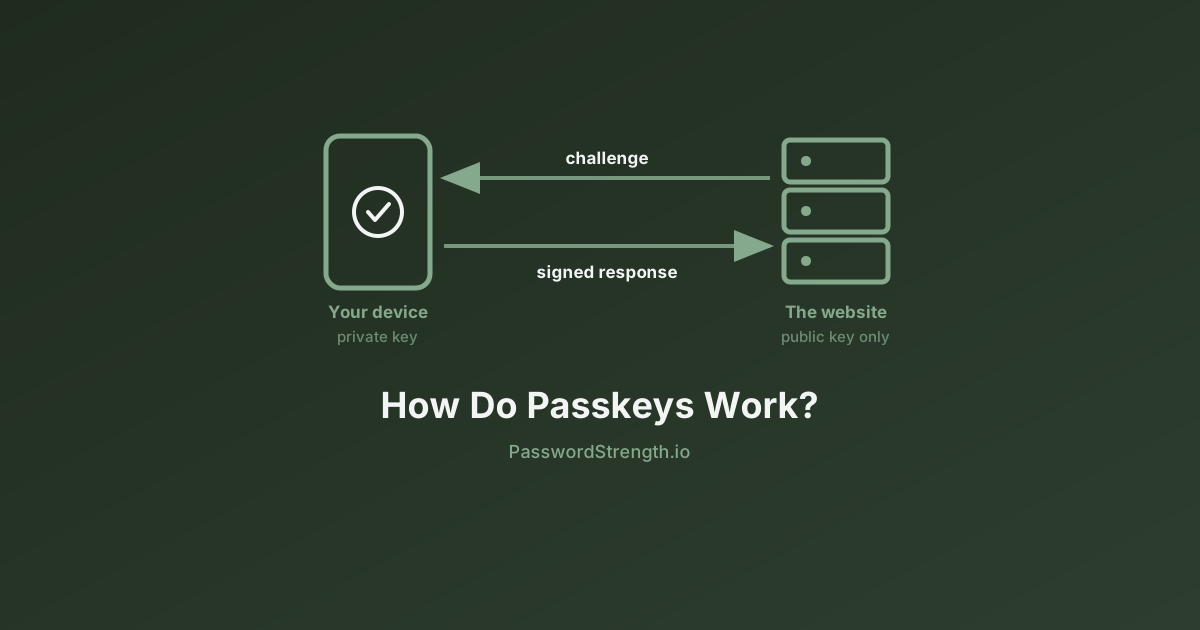
- Security keys or passkey style methods for admins and finance staff
- Authenticator app codes for general workforce accounts
- Push based MFA with number matching when available
- SMS only when stronger options are not yet available
NIST and CISA materials on phishing and account security reinforce the same principle: credentials alone are not enough, and phishing risk must be treated as an identity problem, not just an email filtering problem.
30 day rollout plan for small businesses
Week 1: Scope and inventory
- List critical systems and account owners
- Identify shared credentials and legacy admin accounts
- Define policy and leadership owner
Week 2: Tooling and baseline hardening
- Deploy password manager to all staff
- Enforce unique generated passwords for priority systems
- Turn on MFA for email, finance, and admin consoles
Week 3: Training and phishing drills
- Teach staff how to verify domains before login
- Define escalation path for suspicious messages
- Test the process with short scenario based drills
Week 4: Validate and operationalize
- Audit MFA coverage by system and role
- Remove ex employee access and old recovery methods
- Document incident response playbook for account takeover
If an account is compromised, do this immediately
- Isolate the affected account and force credential reset
- Revoke active sessions and API tokens
- Confirm MFA is enabled and recovery options are clean
- Check for suspicious forwarding rules and privilege changes
- Rotate related secrets stored in connected systems
- Brief leadership with timeline, impact, and next controls
Speed matters, but so does discipline. Preserve logs and document actions as you go. Your notes will drive root cause analysis and insurance or compliance reporting if required.
Conclusion
Small business password security is not a one time project. It is an operating habit: unique credentials, stronger MFA, phishing aware behavior, and fast cleanup when people or systems change. Start with your highest impact accounts, complete one rollout cycle, then iterate quarterly.
Test your password strength now. Use the free Password Analyzer to check entropy, crack time, and common weaknesses in seconds.